


If you're planning a hiking, trekking or backpacking trip, you've probably come across both freeze-dried food and dehydrated food.
At first glance, they seem very similar. Both are lightweight, shelf-stable and designed to make eating outdoors easier. But the way they're produced — and the experience of eating them on the trail — can be surprisingly different.
So what's the difference between freeze-dried and dehydrated food? Which tastes better? Which offers the best value? And which makes the most sense for your next adventure?
Having carried both on routes like the Tour du Mont Blanc and trekking trips in Iceland, here's what I've learned.
What Is Freeze-Dried Food?
Freeze-dried food, also known as lyophilized food, is produced using a process called freeze-drying.
The food is first frozen at extremely low temperatures and then placed inside a vacuum chamber. The frozen water is removed through a process called sublimation, where ice turns directly into vapour without becoming liquid.
This removes approximately 98–99% of moisture from the food.
Freeze-dried meals are popular because they are lightweight, rehydrate quickly and can have exceptionally long shelf lives.
You'll find freeze-dried food used for:
- Backpacking meals
- Mountaineering expeditions
- Emergency food storage
- Military rations
- Polar expeditions
It's an impressive technology and has earned its place in the outdoor world.
What Is Dehydrated Food?
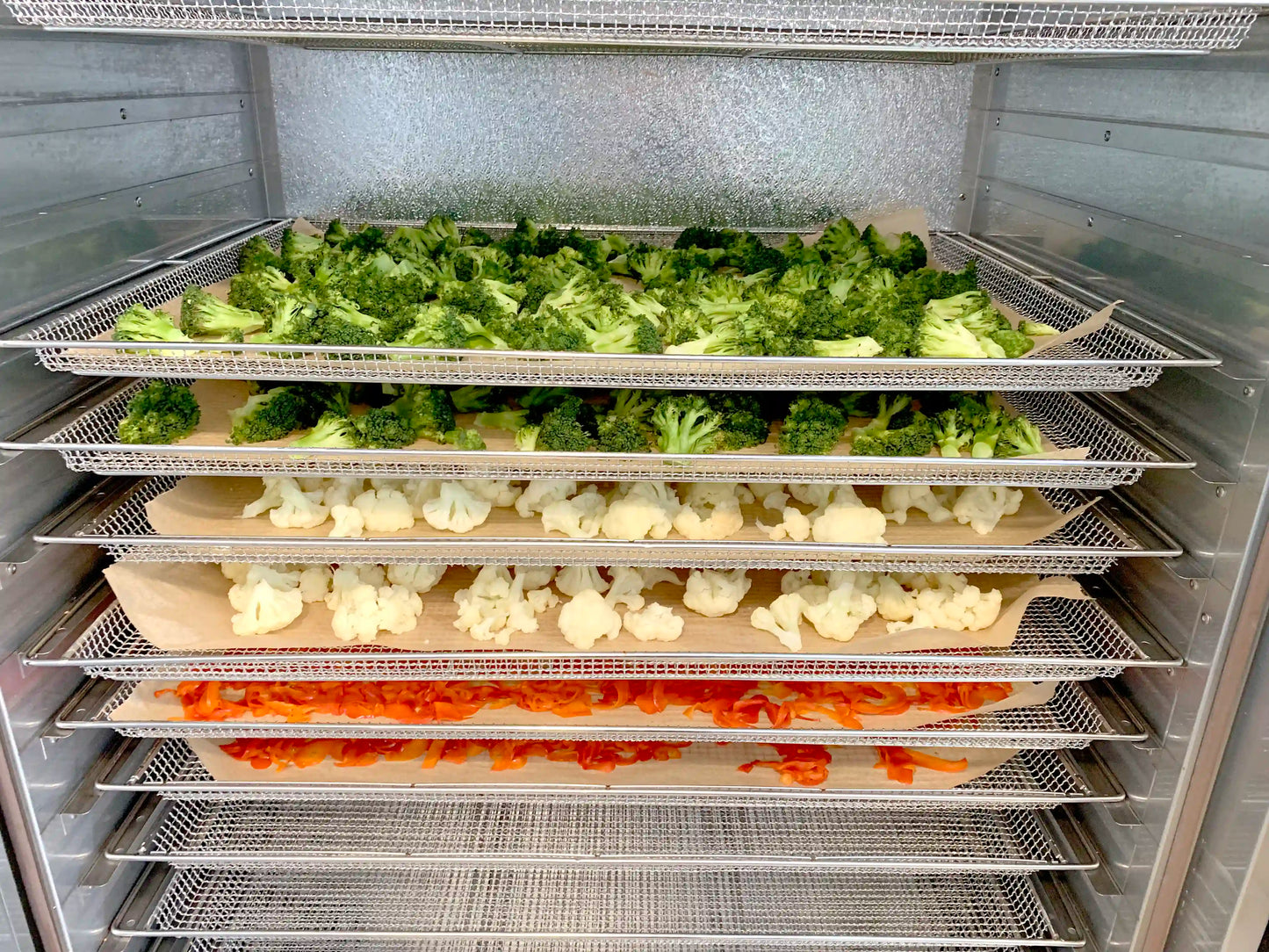
Dehydrated food uses a much simpler process.
Warm air slowly removes moisture from ingredients over several hours while preserving flavour, texture and nutritional value.
Humans have preserved food through dehydration for thousands of years, although modern dehydrators allow much greater precision and consistency.
Most dehydrated foods have approximately 85–95% of their moisture removed.
At Alpibreak, every meal is cooked first and then dehydrated in Geneva.
The goal isn't simply to make food lighter.
The goal is to create meals that still taste like food.
Freeze-Dried vs Dehydrated Food: What's the Difference?
| Feature | Freeze-Dried Food | Dehydrated Food |
|---|---|---|
| Moisture Removed | 98–99% | 85–95% |
| Shelf Life | Up to 25 years | Typically 1–5 years |
| Production Method | Freeze-drying / Lyophilization | Warm-air drying |
| Cost | Higher | Lower |
| Texture After Rehydration | Light, airy | More natural |
| Processing | Highly technical | Simpler and more traditional |
| Best For | Long-term storage, expeditions | Hiking, trekking, camping |
The biggest differences aren't always the ones people expect.
Most hikers focus on shelf life and weight.
But after a few days on the trail, taste often becomes the deciding factor.
Which Tastes Better?
Taste is subjective.
But it's also the reason many hikers start looking beyond traditional freeze-dried meals.
When you're planning a trip from your kitchen table, technical specifications seem important.
When you're sitting outside a tent after eight hours of hiking, what matters is whether you're excited about dinner.
Many freeze-dried meals prioritise maximum shelf life and minimum moisture.
Many dehydrated meals prioritise flavour and texture.
Because dehydrated ingredients aren't frozen and processed through a vacuum system, they often rehydrate into something that feels closer to a home-cooked meal.
Vegetables still have texture.
Grains still have bite.
The meal feels like something that was cooked, not engineered.
After a long day outdoors, that difference matters.
Why Shelf Life Isn't Everything
One of the biggest selling points of freeze-dried food is shelf life.
Some freeze-dried meals can last 10, 15 or even 25 years.
That's impressive.
It's also irrelevant for most hikers.
Most people aren't buying food for a bunker. They're buying food for next weekend, next summer or next year's adventure.
For real-world hiking, trekking and camping, a shelf life of several years is already more than enough.
A properly dehydrated meal can accompany countless adventures long before shelf life becomes a concern.
Why Are Freeze-Dried Meals More Expensive?
Freeze-drying requires specialised industrial equipment and significant energy consumption.
The production process is considerably more complex than dehydration.
As a result, freeze-dried meals are often significantly more expensive than dehydrated hiking meals.
For a single meal, the difference may seem small.
For a week-long trek, it adds up quickly.
Many hikers are surprised to discover that they can enjoy high-quality dehydrated meals at a lower cost while sacrificing very little in practical performance.
Why We Chose Dehydration
When I created Alpibreak, I wasn't trying to build the lightest meal on the market.
I was trying to create food I would genuinely look forward to eating.
Before starting Alpibreak, I spent years hiking and travelling with outdoor meals that were functional but forgettable.
They delivered calories.
They filled a gap.
But they rarely felt like part of the adventure.
After the Tour du Mont Blanc and several trekking trips in Iceland, I started experimenting with my own recipes.
What I wanted was simple:
Real ingredients.
Balanced vegetarian meals.
No preservatives.
Food that tasted good enough to become one of the highlights of the day.
Dehydration turned out to be the best way to achieve that.
Today, every Alpibreak recipe is still cooked and dehydrated in Switzerland using that same philosophy.
Not because dehydration is the most technical solution.
Because it's the one that allows us to preserve flavour and create meals that feel worth carrying all day.
So Which Is Better?
Freeze-dried food is an impressive technology.
It removes more moisture, creates exceptionally long shelf lives and performs well in extreme environments.
But most hikers aren't crossing Antarctica.
They're spending a weekend in the Alps. Walking the Tour du Mont Blanc. Bikepacking across Switzerland. Sleeping beside a lake with friends.
For those adventures, the question isn't which meal survives longest in a warehouse.
It's which meal you'll genuinely look forward to eating after a long day outdoors.
For us, that's where dehydrated food shines.
Frequently Asked Questions
Is freeze-dried food the same as dehydrated food?
No. Freeze-dried food uses freezing and vacuum technology to remove moisture, while dehydrated food uses warm air and controlled drying.
What is lyophilized food?
Lyophilized food is simply another term for freeze-dried food.
Does freeze-dried food last longer?
Yes. Freeze-dried meals can last significantly longer than dehydrated meals when stored properly.
Are dehydrated meals good for backpacking?
Absolutely. Dehydrated meals are lightweight, compact, shelf-stable and widely used for hiking, trekking, bikepacking and camping.
Why does Alpibreak use dehydration instead of freeze-drying?
Because dehydration allows us to create meals with a more natural texture and flavour while keeping ingredients simple, shelf-stable and easy to prepare on the trail.
The Bottom Line
Freeze-dried food and dehydrated food both have their place in the outdoor world.
If your priority is maximum shelf life, freeze-dried meals are hard to beat.
But if your priority is flavour, value and meals that feel closer to real cooking, dehydrated food is often the better choice.
Adventure is hard enough.
Dinner shouldn't be.